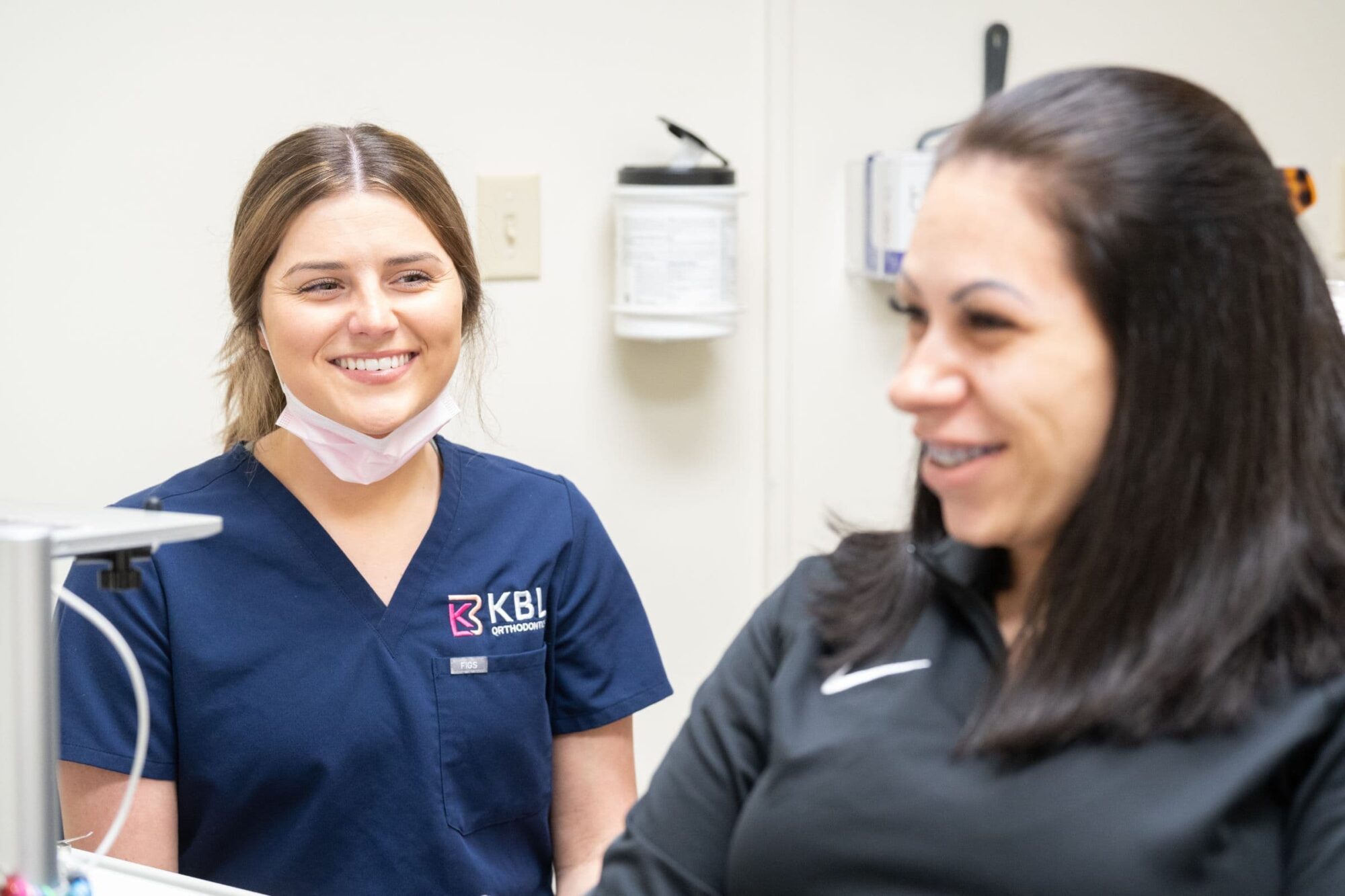
Is it too late for braces? The short answer is no. Teeth can be moved at nearly any age, as long as the bone and gums holding them are healthy. Adult orthodontics means correcting alignment and bite issues after facial growth is finished.
Age matters far less than the condition of your mouth. Healthy gums, stable bone support, and teeth free of untreated decay are what make treatment work, whether you’re 28 or 68.
Adult treatment is also more common than most people expect. According to the American Association of Orthodontists, roughly one in four orthodontic patients today is an adult.
Most adults come in for one of a few reasons:
- Crowding that has slowly gotten tighter over the years
- Gaps or spacing that never closed
- Bite issues like an overbite, underbite, or crossbite
- Teeth that shifted back after braces in childhood, usually because retainer wear stopped
Dr. Katie B. Lewis sees all of these cases regularly at KBL Orthodontics. Some patients wore braces as teens and want their smile back. Others never had the chance the first time around and are finally doing something for themselves.

How Adult Orthodontic Treatment Works, Step by Step
Adult orthodontic treatment follows five steps: a free consult with records, a diagnosis of your alignment and bite, a custom plan, active treatment with braces or clear aligners, and retainers to hold your new smile in place. Most adults finish in roughly 12 to 30 months.
Here’s what each stage looks like in practice.
- Free consult. Dr. Lewis reviews your records, listens to what bothers you about your smile, and answers your questions. Photos, digital X-rays, and a digital scan replace the messy impression trays of the past.
- Diagnosis. Crowding, spacing, deep bite, open bite, overbite, underbite, and crossbite each call for a different approach. This step identifies exactly what’s happening and why.
- Custom treatment plan. You’ll see your options side by side with an estimated timeline. Dr. Lewis and our team build the plan around what will fit your lifestyle best.
- Active treatment. Braces get bonded to your teeth in a single visit, or you’ll pick up your first set of aligner trays. From there, you’ll come in for adjustments or new trays roughly every four to eight weeks.
- Retainers. Once your teeth reach their new positions, retainers keep them there. This step is not optional if you want your smile to last.
One honest note about adult treatment: bone remodels more slowly in adults than in growing teens, so the same correction can take a bit longer. That’s just how adult bone works. Dr. Lewis builds that timing into your plan from the start, so you know what to expect before you begin.
Benefits of Straightening Your Teeth as an Adult
Straightening teeth as an adult improves oral hygiene, bite comfort, and long-term dental health. Aligned teeth are easier to clean, distribute chewing force more evenly, and give future dental work a stable foundation. Those are the reasons most adults at KBL Orthodontics finally decide to move forward, and the cosmetic payoff comes along with them.
- Cleaning gets easier. Crowded, overlapping teeth trap plaque in spots a toothbrush can’t reach. Aligned teeth lower your risk of decay and gum disease over the long run.
- Less abnormal wear. When your bite doesn’t meet evenly, certain teeth absorb more force than they should. That leads to flattened edges, chipping, and enamel damage that only gets worse with time.
- More comfortable chewing. Bite issues can make chewing awkward and contribute to jaw tenderness. Correcting how your teeth meet often brings real relief.
- How you carry yourself. Straight teeth help your oral health, and they can also change how you carry yourself in meetings, interviews, and social settings.
- Discreet options keep life normal. Clear aligners and clear braces let you go through treatment without announcing it to every client and coworker.
- A better foundation for future dental work. If crowns, veneers, or implants are in your future, straightening first gives your dentist better spacing and a more stable bite to work with.
Plenty of adults tell us they wish they’d started sooner. Almost none of them regret starting at all.
Adult Treatment Options Compared: Clear Aligners vs. Clear Braces vs. Metal Braces
Adults at KBL Orthodontics generally choose between four options. Here’s how they compare.
| Option | Visibility | Removable | Typical Duration | Handles Complex Bites | Daily Upkeep |
|---|---|---|---|---|---|
| Clear aligners (3M Clarity) | Nearly invisible | Yes | About 12 to 24 months | Mild to moderate cases | Wear 20 to 22 hrs/day, rinse trays, brush after meals |
| Clear braces (Clarity Advanced ceramic) | Tooth-colored, low profile | No | About 18 to 30 months | Yes, including detailed corrections | Brush around brackets, limit staining foods |
| Modern metal braces | Visible but smaller than years past | No | About 18 to 30 months | Yes, strongest option for tough bites | Brush and floss around brackets, avoid hard foods |
| Champagne braces | Subtle muted metallic finish | No | About 18 to 30 months | Yes | Same as metal braces |
Clear aligners are a common choice at KBL Orthodontics because they get the job done without interrupting your daily routine. These clear, removable trays are personalized to fit closely over your teeth. The tradeoff is discipline. Aligners only work while they’re in your mouth.
Clear braces use translucent ceramic brackets that blend with your natural tooth color and resist staining. You get precise control over detailed movements with a discreet look, and nothing to remember to put back in.
Modern metal braces have advanced and no longer require the bulky headgear of years past. Brackets are smaller, and the system remains the most durable and predictable choice for correcting significant bite issues.
Champagne braces offer a middle ground. The muted finish blends in more than bright silver while keeping the strength of a fixed appliance.
Your lifestyle matters here as much as your bite. Frequent travel, contact sports, daily presentations, and how honest you are about your own follow-through all belong in the conversation. Dr. Lewis will walk you through it during your free consultation.
Are You a Candidate for Adult Orthodontics?
Most adults are candidates for orthodontic treatment. Dr. Lewis looks at the health of your mouth, not the number on your driver’s license: healthy gums, stable bone support, and no untreated decay are the three requirements. When those boxes are checked, age simply is not the deciding factor.
You’re likely a good candidate if you have:
- Healthy gums with no active gum disease
- Stable bone support around your teeth
- No untreated decay or infection
- A specific concern you’d like corrected, whether that’s crowding, gaps, a deep bite, an open bite, a crossbite, or teeth that relapsed after childhood braces
A few situations call for coordinated care first:
- Active gum disease needs treatment and stabilizing before teeth are moved
- Missing teeth may change the plan, since spaces sometimes need to be held open for future implants
- Heavy existing restorations like multiple crowns or bridges require careful planning with your general dentist
Fit matters too. Clear aligners reward self-disciplined patients who will keep trays in 20 to 22 hours a day. Braces suit anyone who’d rather have a fixed appliance doing the work without daily decisions.
We treat adults in their thirties, forties, fifties, sixties, and beyond. Dr. Katie B. Lewis completed 11 years of training to do this work: four years of college, four years of dental school, and three years of orthodontics residency. Out of 100 dental school graduates, on average, only about six go on to become orthodontists.
The only way to know for certain is an exam. A free consultation gives you an individual assessment with no obligation attached, and it answers the questions you can’t settle on your own: what’s actually going on with your bite and which options fit your life. Plenty of adults think it over for years before making that call, and there is no wrong time to ask. With Dr. Lewis’s experience and expertise on your side, you’ll know your smile’s in the right hands whenever you decide the timing is right.
Frequently Asked Questions About Braces for Adults
Am I too old for braces?
There is no upper age limit for orthodontic treatment. As long as your teeth, gums, and supporting bone are healthy, teeth can be moved and bites can be corrected. Dr. Lewis regularly treats adults who assumed they had missed their window entirely.
How long do adult braces take?
Most adult cases run about 12 to 30 months. Minor crowding or a small relapse can wrap up on the shorter end, while bite correction takes longer. Because adult bone remodels more slowly than a growing teen’s, the same correction may take somewhat longer than it would have at 14.
Do braces feel uncomfortable as an adult?
Expect mild tenderness for a few days after your braces are placed and after adjustments, along with a similar feeling when you switch to a new aligner tray. Most people describe it as pressure rather than anything sharp, and over-the-counter relief plus soft foods handles it easily. That tenderness fades quickly as your teeth settle into their new positions.
Can I get invisible orthodontic treatment?
Yes. Clear aligners are the most discreet option since they’re removable and nearly invisible. Clear ceramic braces blend with your natural tooth color, and champagne braces offer a muted metallic finish that draws far less attention than bright silver brackets.
Do I need to wear retainers forever?
Teeth naturally want to drift throughout your life, so long-term nighttime retainer wear is the standard recommendation for keeping your results. Think of it as a small habit that protects a real investment. Skipping retainers is the most common reason adults end up needing treatment a second time.